Between the depths of the ocean and the laboratory, between 3D printing and meticulous craftsmanship – the new exhibition of fashion designer Iris van Herpen at the Brooklyn Museum is not just a fashion show. It is a hypnotic journey into the intersection of science, nature, and design, dismantling the boundaries of clothing and transforming it into living sculpture in motion.
Iris van Herpen is an unconventional fashion designer. Her work processes involve tools and materials one might expect to find in a garage or a chemistry lab, combined with inspirations from nature – and when a creation begins like this – it is instantly mesmerizing. She blends meticulous, traditional couture craftsmanship with advanced technologies such as 3D printing and laser cutting. Van Herpen is an icon in the world of haute couture, and her dresses have been worn by stars like Beyoncé, Lady Gaga, Björk, and more.
The exhibition Sculpting the Senses, currently on display at the Brooklyn Museum, offers a broad look at the body of work the fashion designer has developed throughout her career. Through more than 140 pieces, the exhibition explores the intersections of art, nature, science, technology, and human perception, raising questions about the directions design might evolve in the future.
—
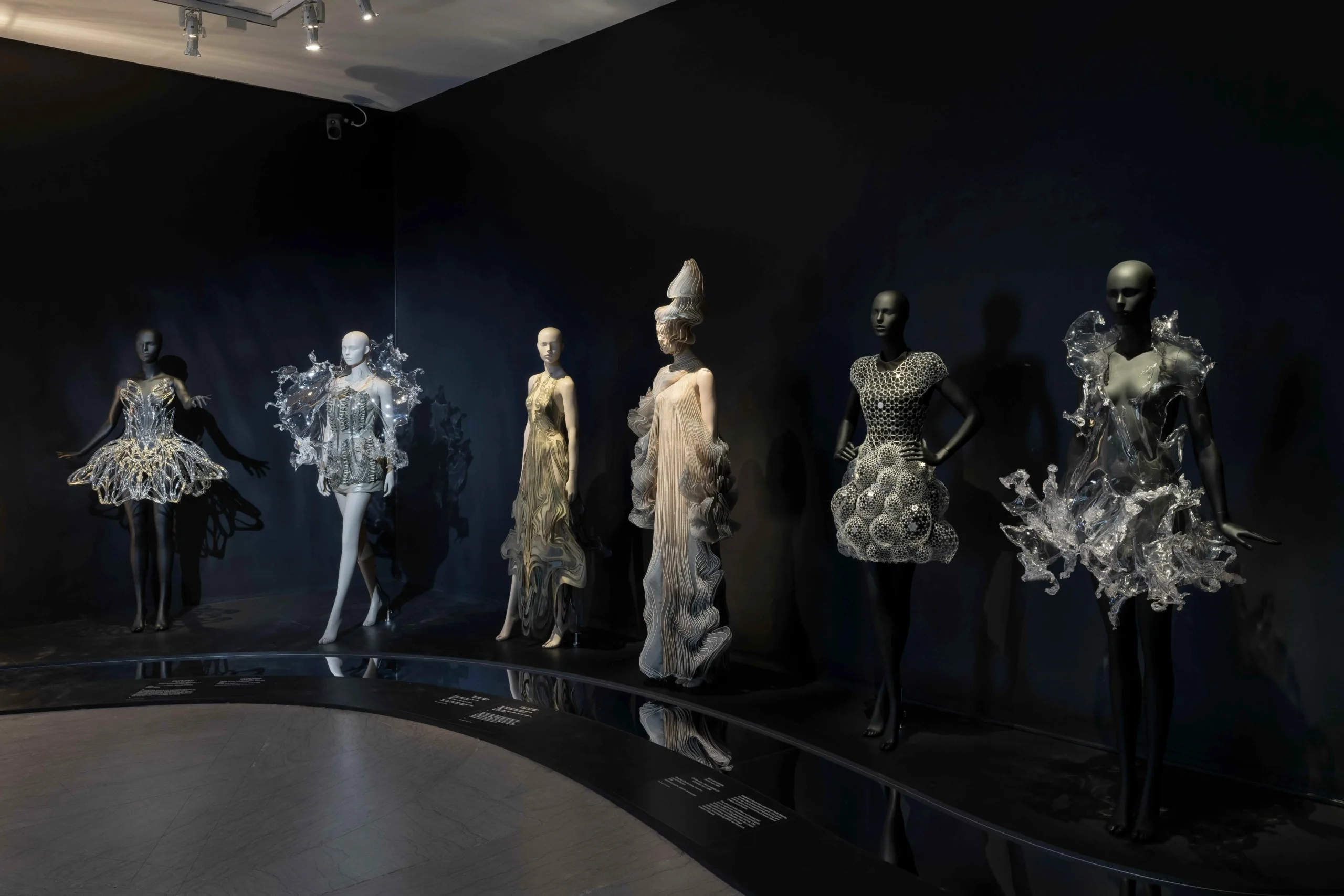
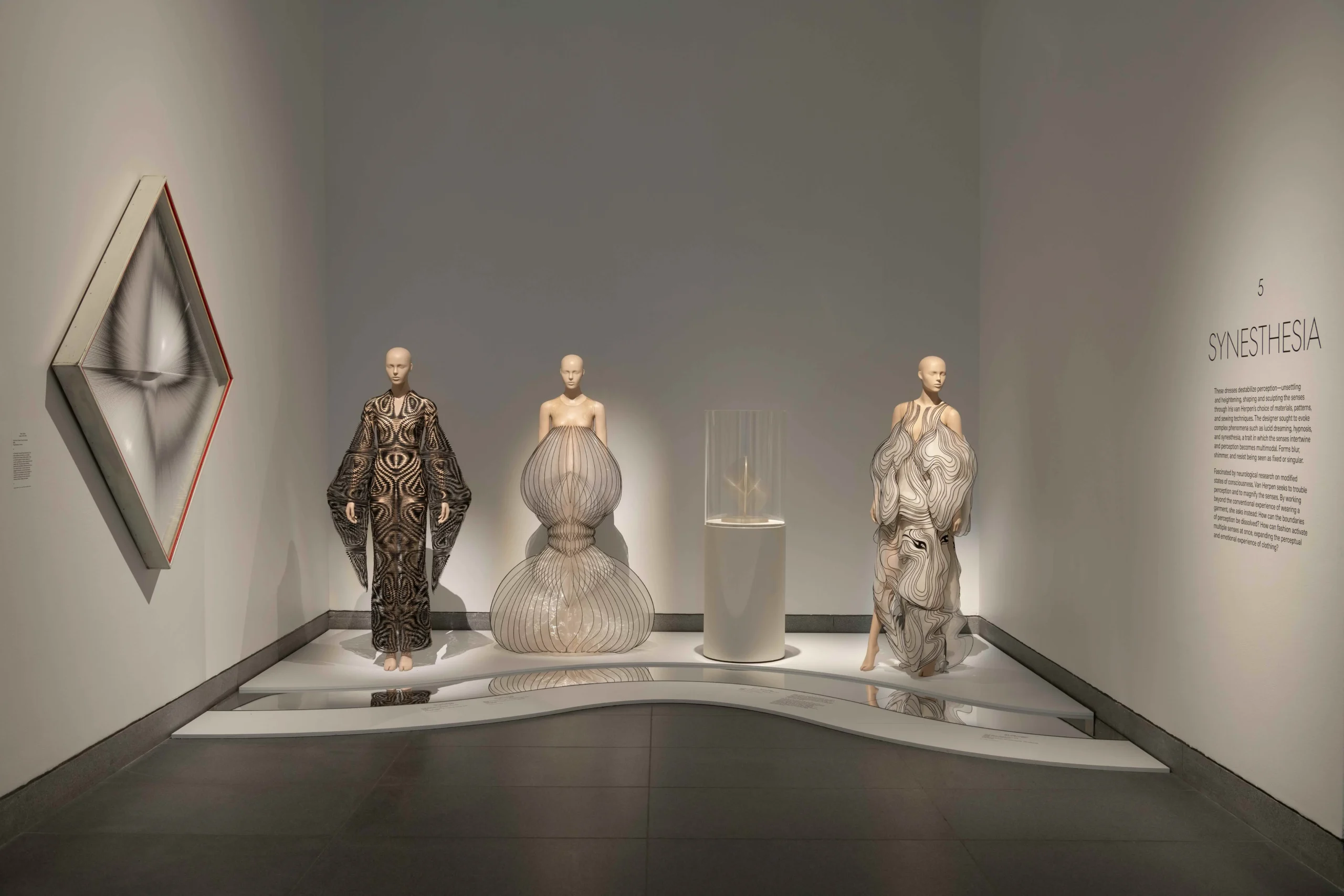
Installation view of Iris van Herpen: Sculpting the Senses, Brooklyn Museum, 2026. Photo: Paula Abreu Pita
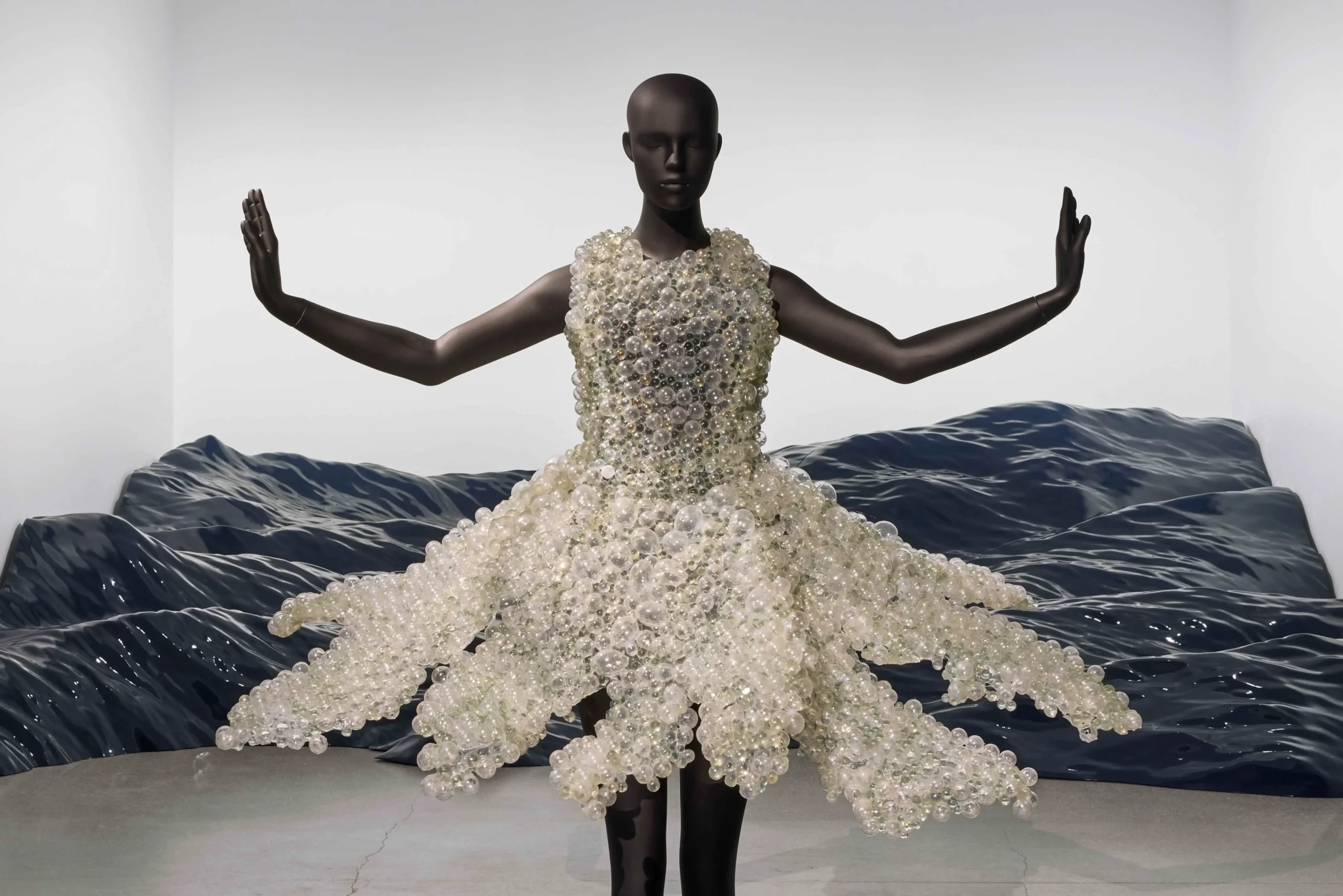
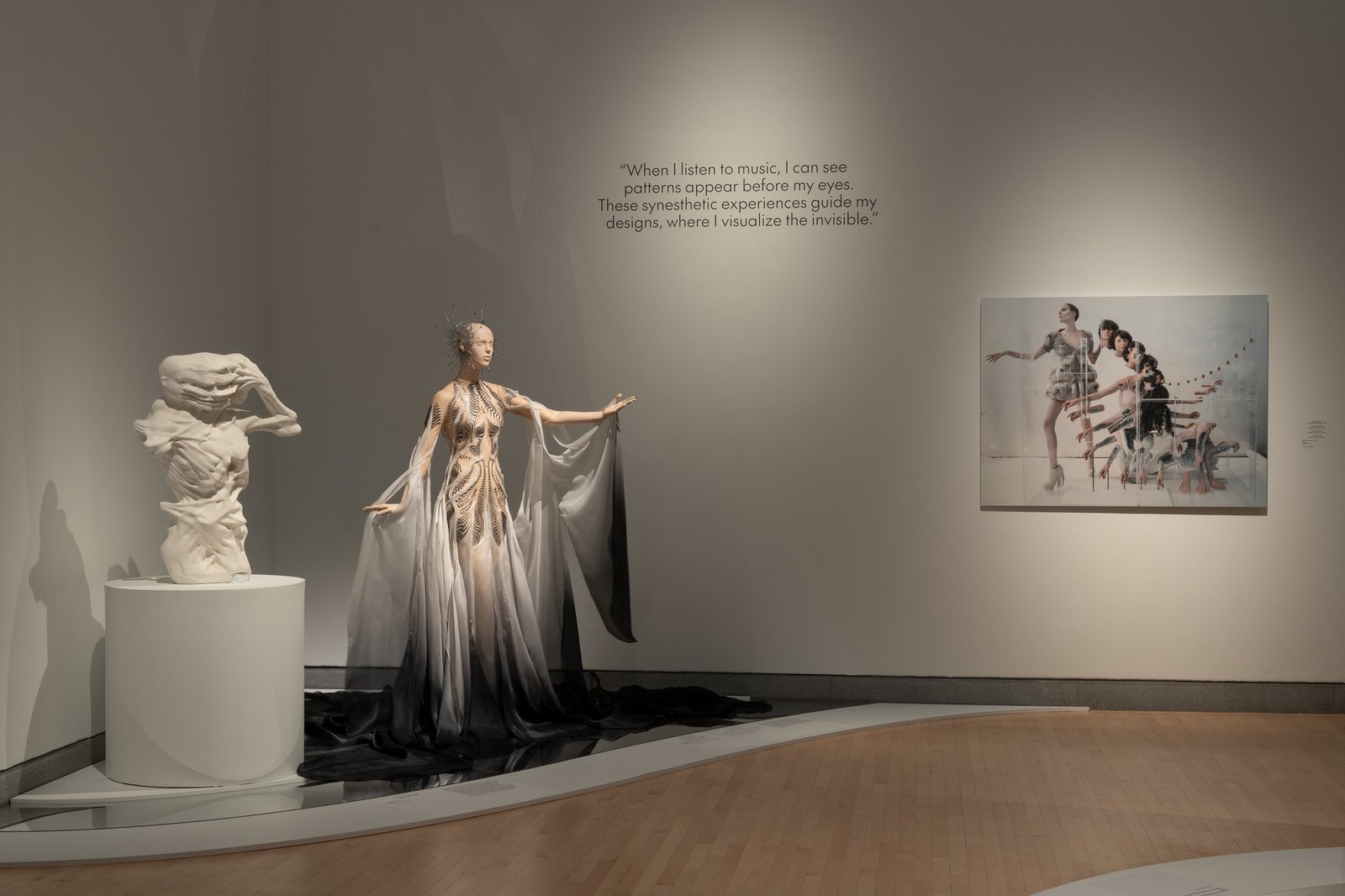
Installation view of Iris van Herpen: Sculpting the Senses, Brooklyn Museum, 2026. Photo: Paula Abreu Pita
The exhibition leads visitors through different stations, each dedicated to a distinct system of forms and phenomena. From the depths of the ocean, through insects and fungi, to outer space and futuristic fantasies. The exhibition reveals how the artist translates the principles behind these into a new material language.
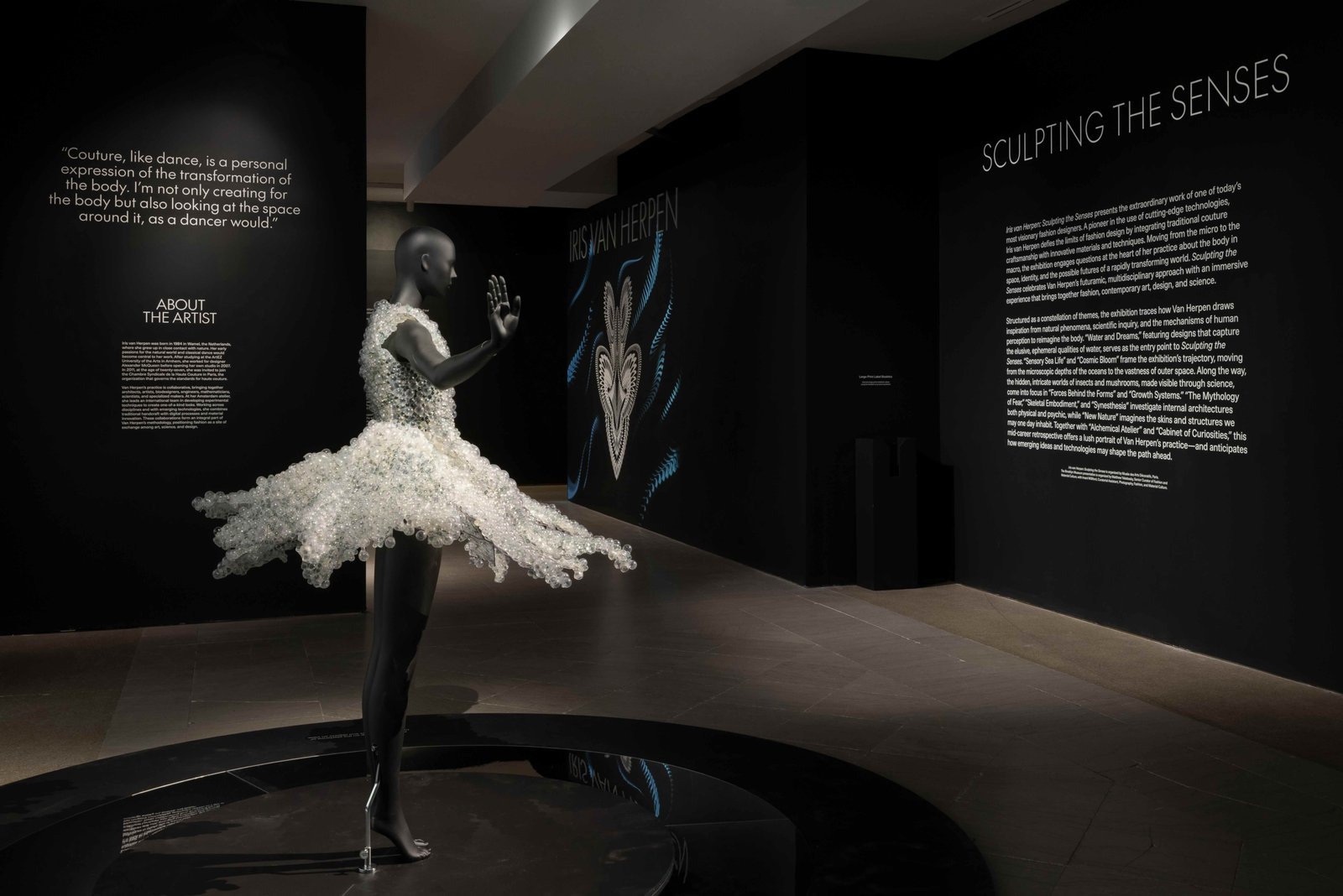
In the opening space of the exhibition, Water and Dreams, Van Herpen’s dresses illustrate the materiality of water in its various states of matter and changing intensities of motion. Elements like mist, waves, or ice can be recognized within them. The dress Airo, which opens the exhibition, consists of about 15,000 hand-blown glass bubbles attached one by one to the fabric using UV radiation. The dress integrates a mechanism that regulates the release of soap bubbles into the air, so that bubbles form and disperse around the body autonomously. The dress was worn at the Met Gala last May by Olympic skier Eileen Gu, and was created in collaboration with the artist duo A.A.Murakami.
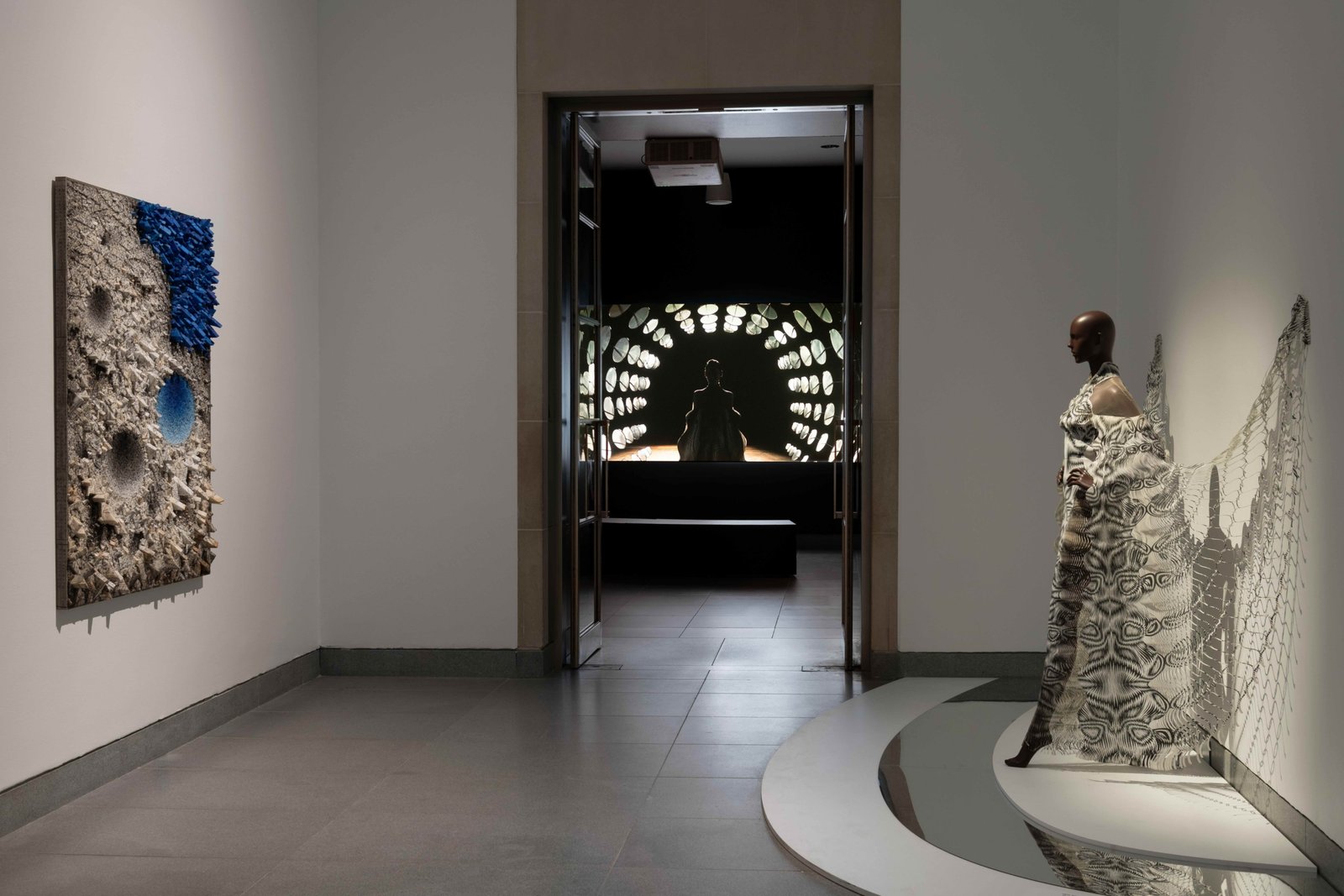
Installation view of Iris van Herpen: Sculpting the Senses, Brooklyn Museum, 2026. Photo: Paula Abreu Pita
Even in this first room, the successful use of mirrors placed beneath the mannequins is striking. The materials of the garments dissolve into further directions, lines elongate and curve, and the objects gain a floating, fluid quality. The reflections create an additional dimension of depth, as if the dresses continue to exist beneath the ground.
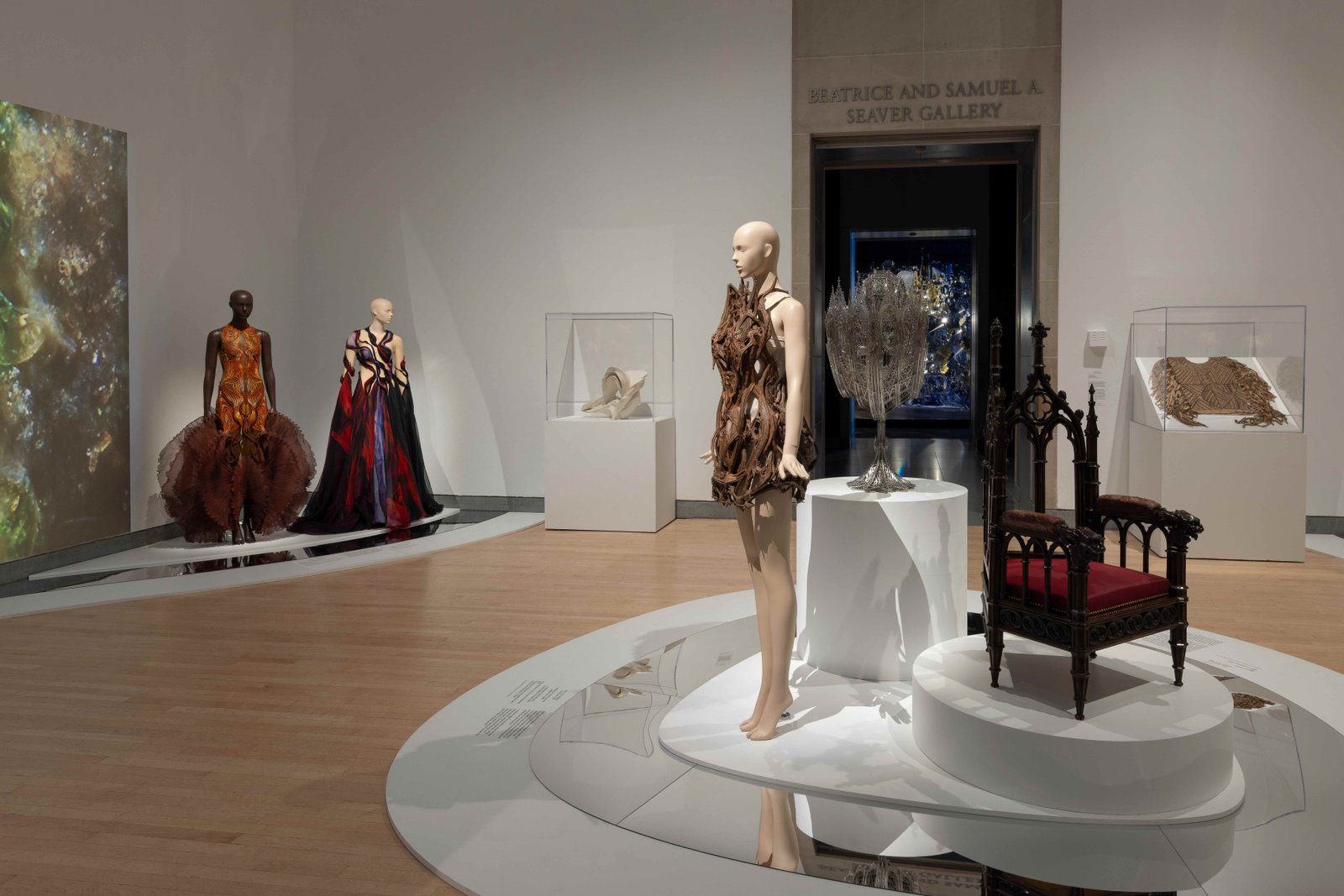
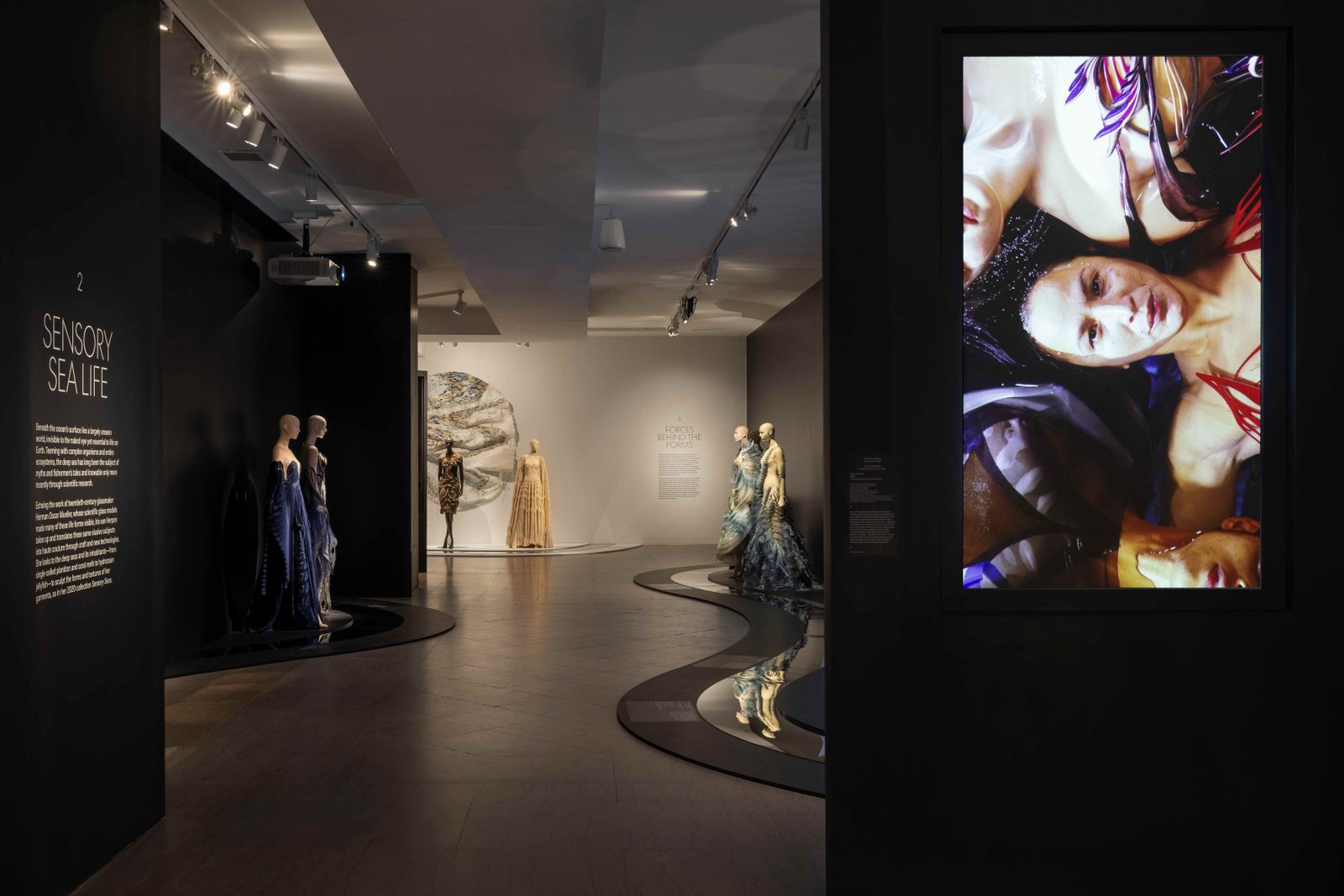
The path winds into the next space – Sensory Sea Life, which vividly demonstrates the analytical way Van Herpen utilizes inspiration. The dresses are inspired by the structural forms of marine organisms such as corals, jellyfish, and plankton. Interestingly, the design does not mimic existing patterns but rather seeks to understand the geometric or organic principle that allowed these structures to develop. Van Herpen investigates the foundational unit, the formal essence of the phenomenon that interests her, and only then begins to build a new world of shapes.
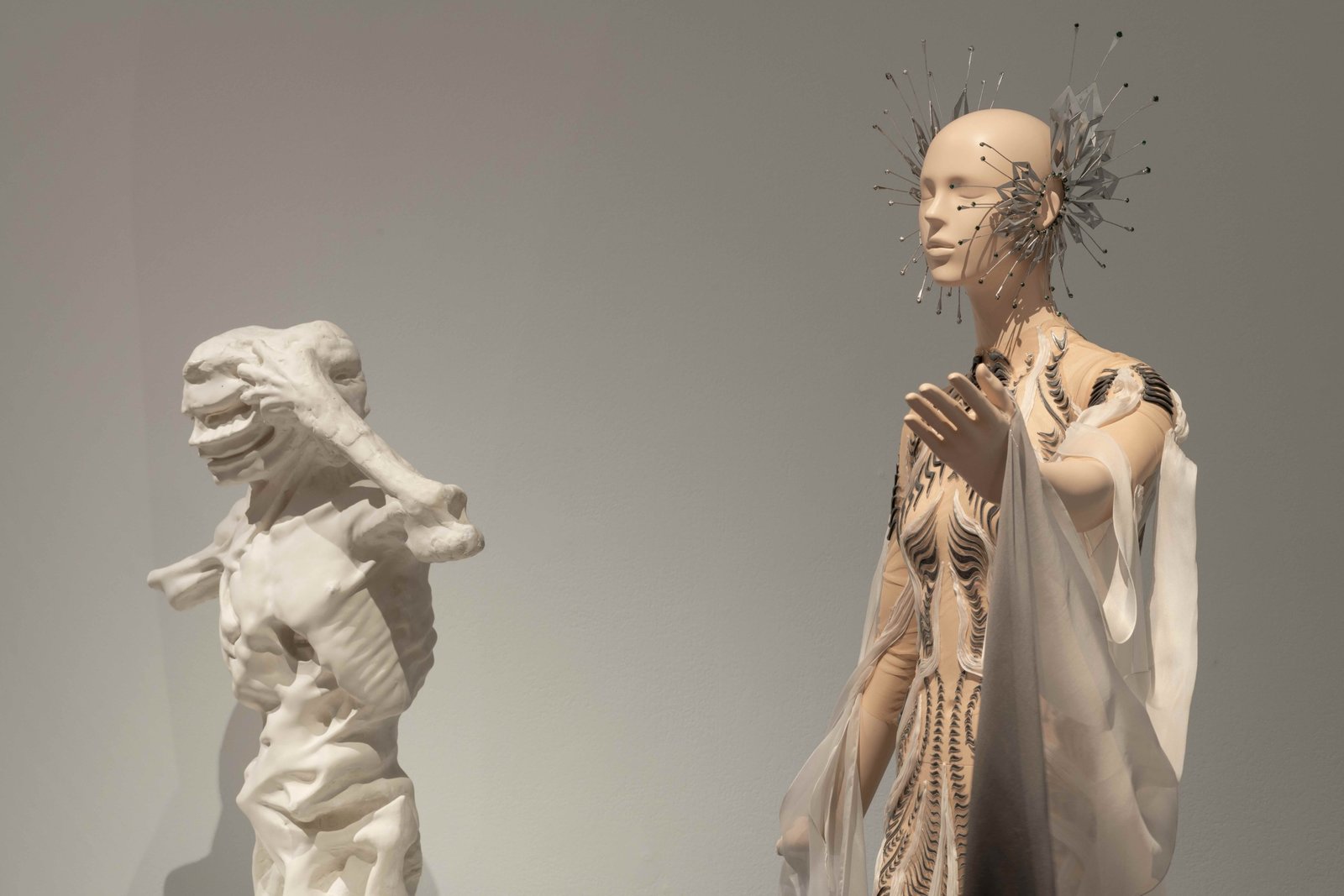
Installation view of Iris van Herpen: Sculpting the Senses, Brooklyn Museum, 2026. Photo: Paula Abreu Pita
STAY CURIOUS
The dress “Hydrozoa” worn by Lady Gaga in 2020, is constructed from delicate laser-cut PETG arches heat-bonded to layers of digitally printed glass organza made from synthetic threads thinner than a human hair. The dress was engineered so that its movement mimics the gentle, cyclical motion of corals with ocean currents.
The garments Van Herpen creates do not feel like a citation of nature, but rather an extension of it – a derivative of the recurring laws that shape it. This is perhaps one reason why they manage to look simultaneously so familiar and so alien. There is something about them that feels entirely organic, even when the final result looks like it arrived from an imaginary world.
At the center of the exhibition is the Alchemical Atelier space, which serves as a sort of archive or materials library. Spread across the walls are material swatches, visual research, development processes, scribbles, and sketches. Visitors can also find pieces of the dresses that are allowed to be touched, alongside samples that can be examined under a microscope. The opportunity to experience the materials physically is a surprising and exciting addition, though slightly disappointing in its limited scale; it could have been granted a larger space.
One of the displayed items is Van Herpen’s sketchbook featuring illustrations of the dresses. The illustrations themselves are spectacular, but the book feels more like a catalog. Right here, I would have loved to see the less polished moments of the process.
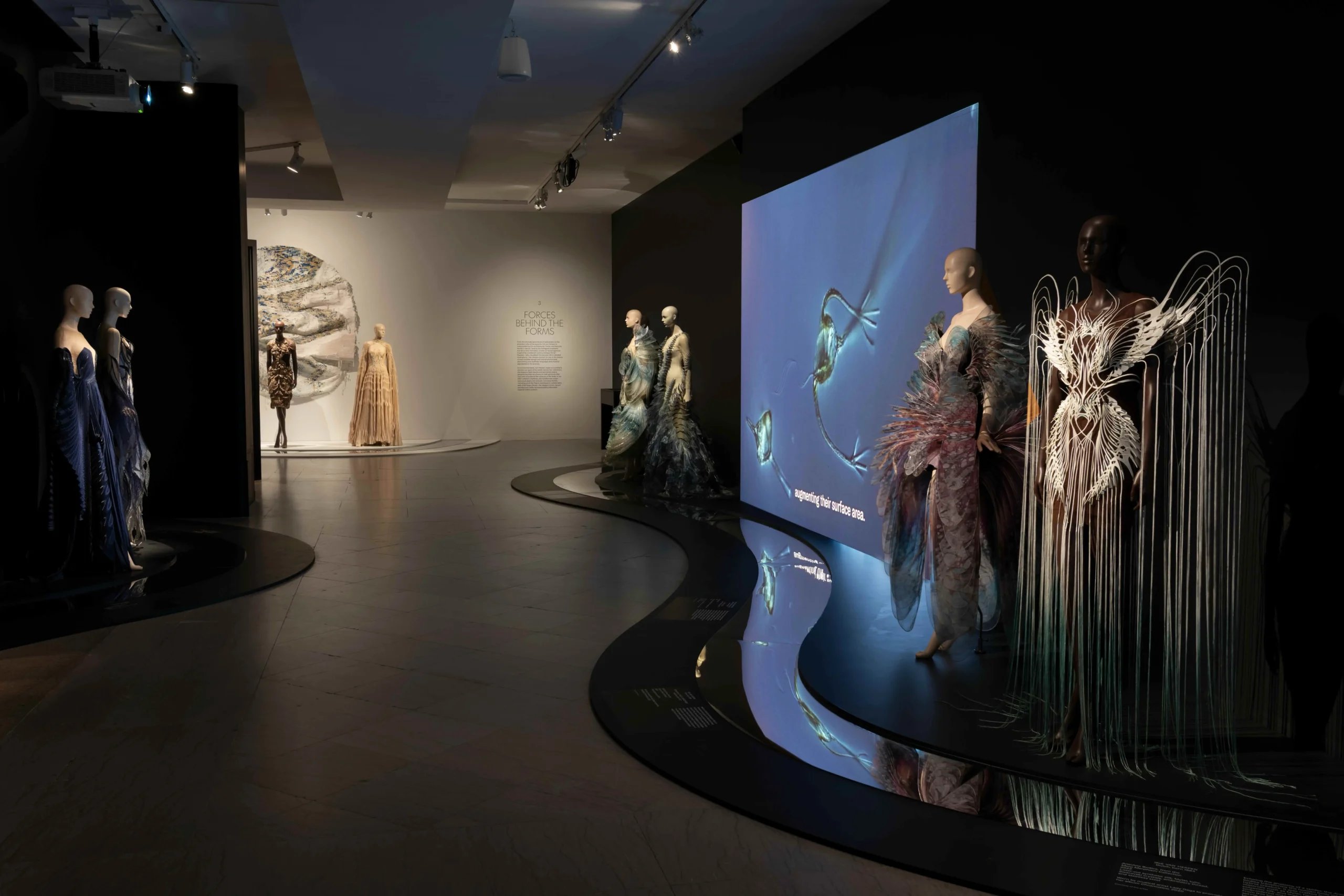
The exhibition impressively showcases the final result and the research behind it, but provides only a limited glimpse into the intermediate moments of searching and consolidation. It is hard not to crave slightly less mediated access behind the scenes, as this organized space still maintains a certain distance from the viewer. A generous compensation for this is found in the video clips showing material experiments, collaborations with artisans, and the unique techniques used to create the garments. It is definitely worth stopping and dedicating time to them.
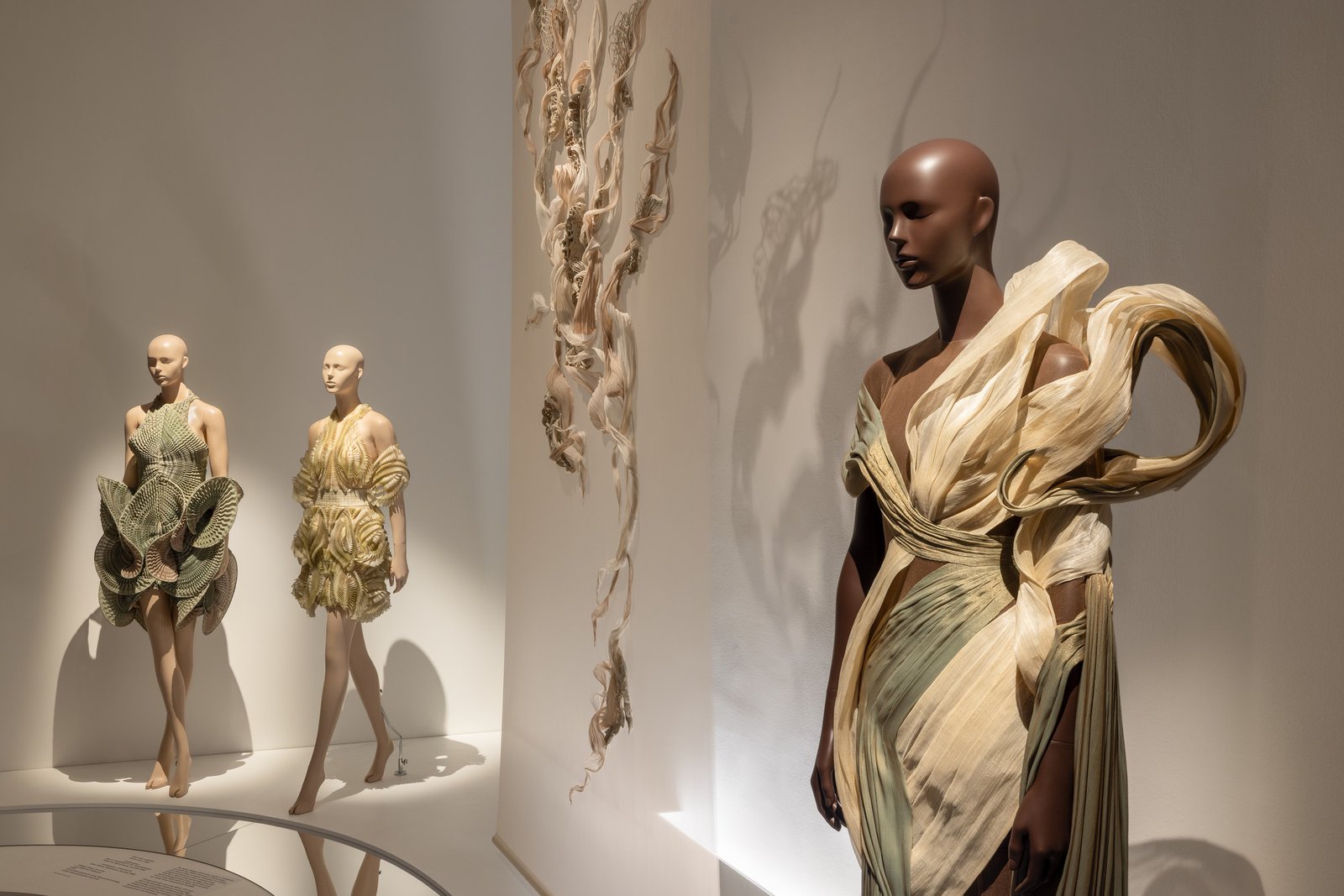
When you stop to observe the shadows of the garments, you discover how complex they truly are: layer upon layer, different materials, tiny details
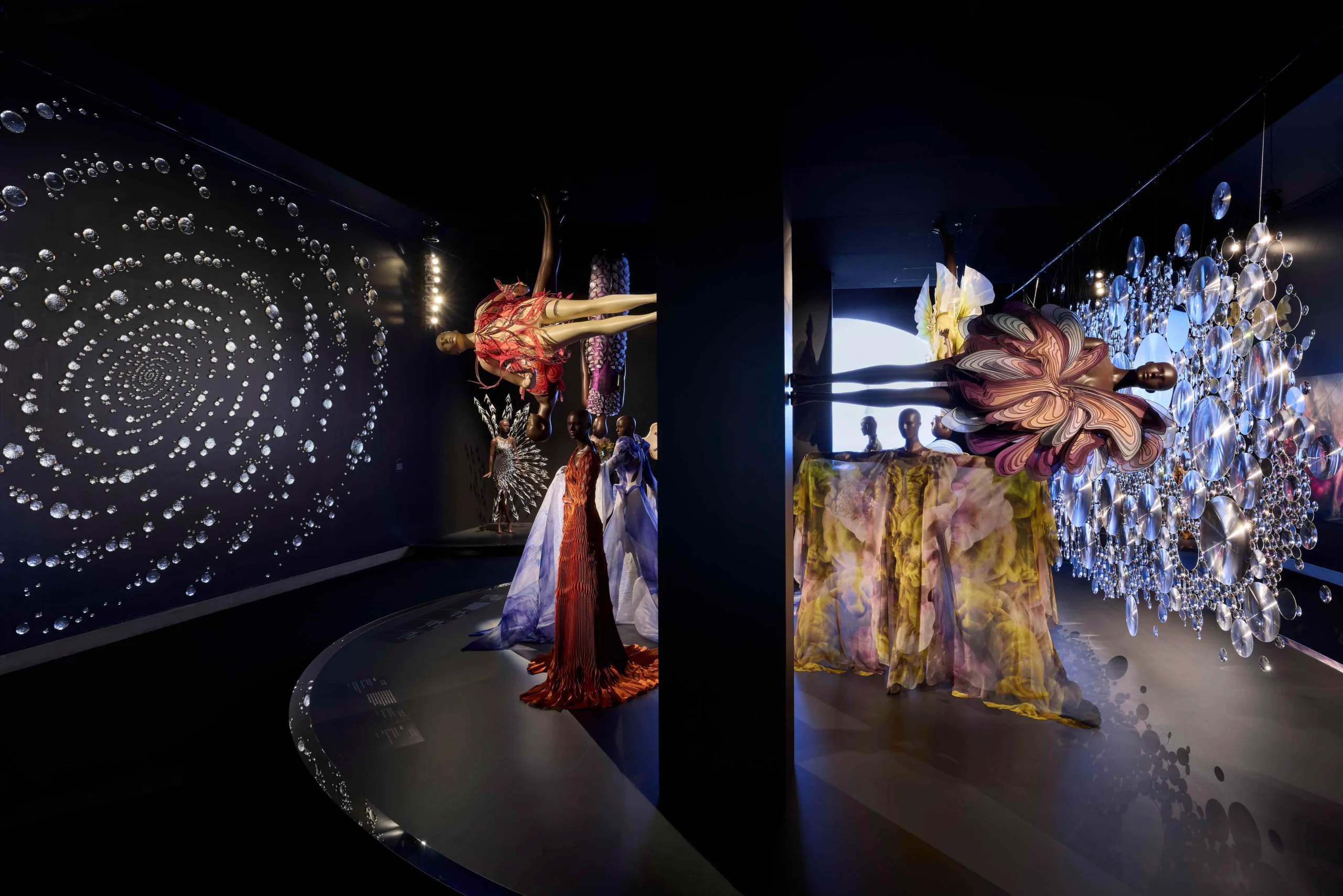
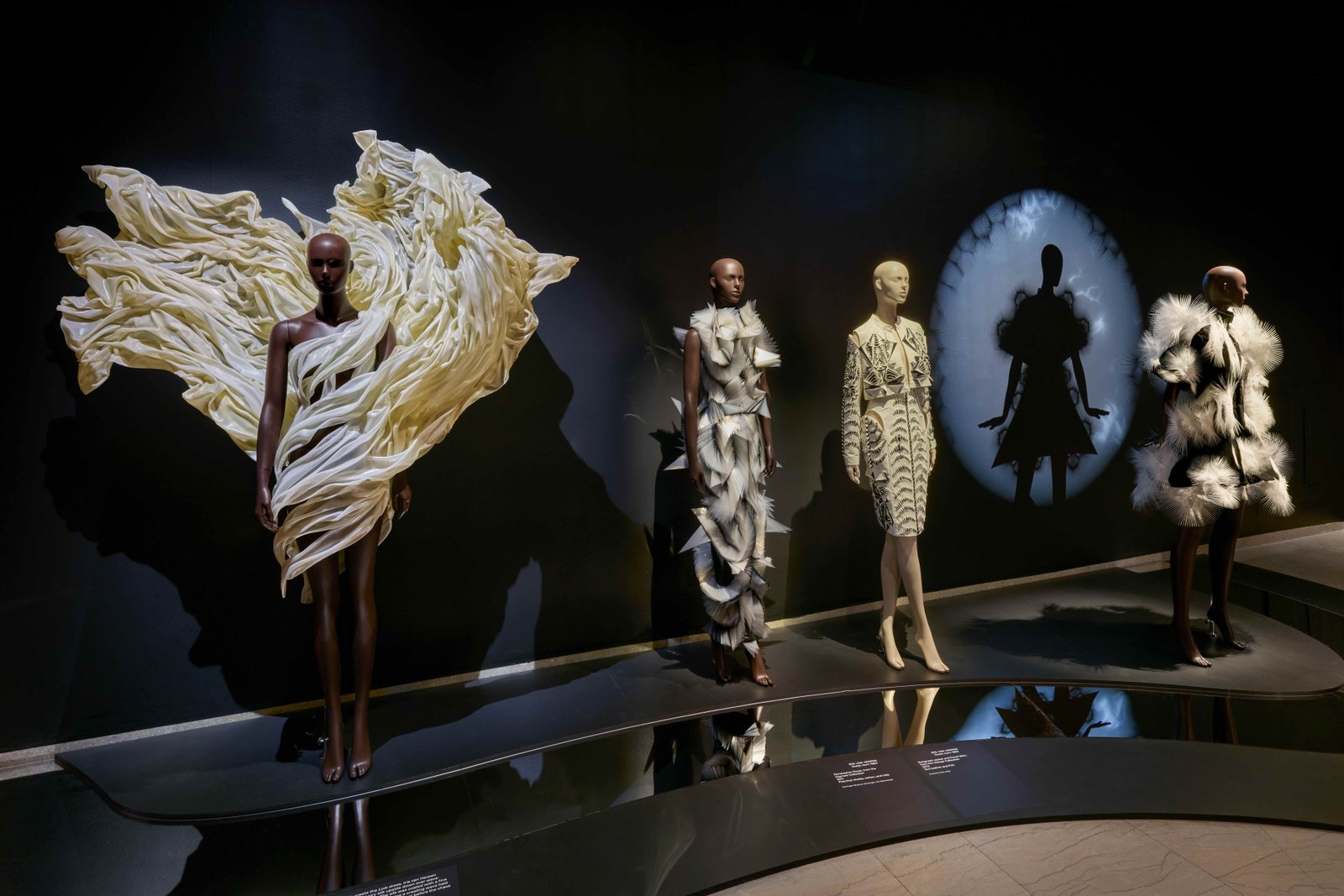
One of the most beautiful features of the exhibition is the shadows. When you stop to observe the shadows of the garments, you discover how complex they truly are: layer upon layer, different materials, tiny details. The shadow performs an interesting move: it simplifies the form in a way that actually emphasizes the three-dimensionality of the works, highlighting what the eye does not fully capture at first glance – perhaps due to the sensory overload of details.
This effect is particularly present in the Synesthesia space, which is small compared to the others and feels like a transitional passage between stations, but is actually one of the most fascinating parts of the exhibition. The space corresponds with ideas from neuroscience and consciousness studies, such as lucid dreaming, hypnosis, and synesthesia, which the designer explores.
Installation view of Iris van Herpen: Sculpting the Senses, Brooklyn Museum, 2026. Photo: Paula Abreu Pita
Installation view of Iris van Herpen: Sculpting the Senses, Brooklyn Museum, 2026. Photo: Paula Abreu Pita
The layers of material composing the dresses create negative spaces where light and air penetrate at various angles, giving vitality to the garment even when it is stationary. This is amplified when watching the video clips, where the dresses are seen worn on a moving body along runway fashion shows. You can see materials opening, vibrating, and responding to the body and the space. Shapes that seemed solid become airy, and elements that looked entirely engineered take on an organic quality.
A spectacular example is the hypnosis cape dress from the 2019 Hypnosis collection. The dress is made of layers of satin and Mylar sheets, laser-cut into thousands of tiny wavy elements. With every movement of the body, the garment’s surface changes faster than the human eye can fully process, and the pattern appears to split and rearrange itself, like looking into a kaleidoscope.
Installation view of Iris van Herpen: Sculpting the Senses, Brooklyn Museum, 2026. Photo: Paula Abreu Pita
Installation view of Iris van Herpen: Sculpting the Senses, Brooklyn Museum, 2026. Photo: Paula Abreu Pita
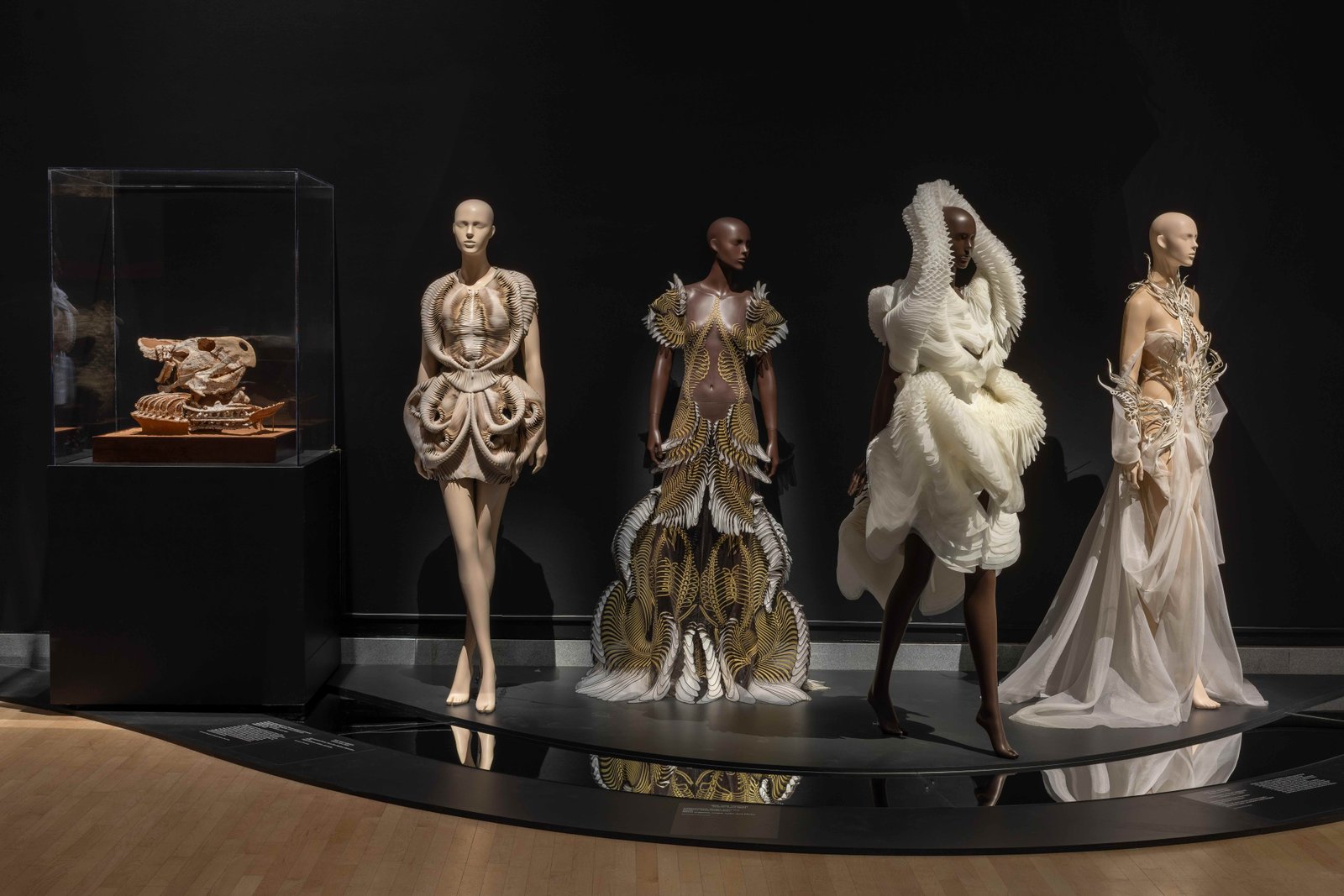
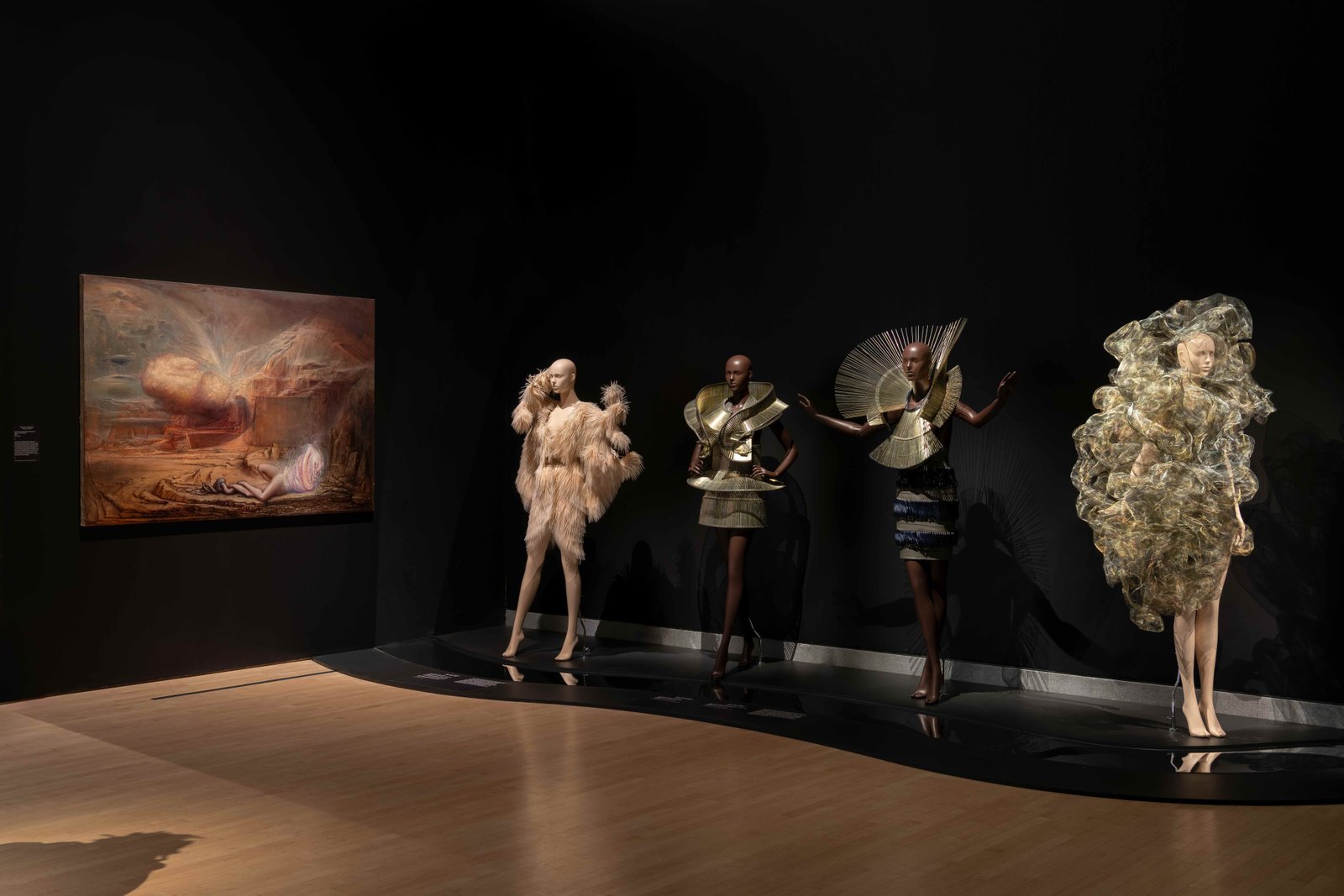
Throughout the exhibition, the dresses are accompanied by diagrams, photographs, microscopic close-ups, sculptures, and artworks from the thematic worlds that inspired them. They appear as part of the story the exhibition seeks to tell, and their presence alongside the final result allows a glimpse into how the artist transforms an idea into a form.
This is especially interesting in the Skeletal Embodiment room, which addresses the relationship between anatomy and material. Here too, Van Herpen dives into the micro-level and explores internal structures – visual references reminiscent of veins and arteries can be identified in the dresses.
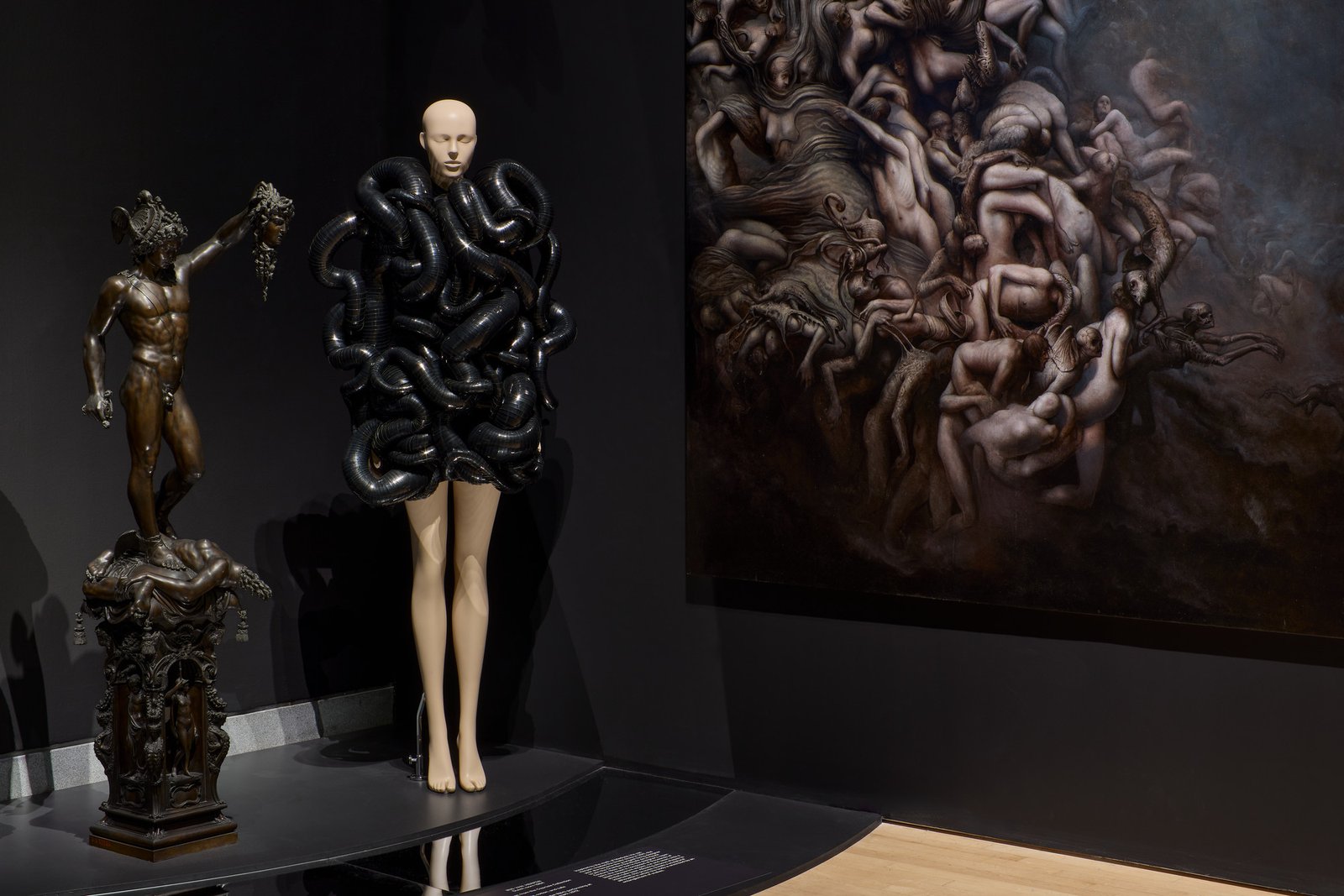
The soundtrack accompanying the exhibition, created by composer and music producer Salvador Breed — Van Herpen’s partner — functions beautifully within the space. It also contributes to the natural transition into the adjacent room, The Mythology of Fear, where the designer turns to the worlds of mythology, alchemy, and surrealist literature, exploring figures and creatures on the boundary between the human and non-human. Sources of inspiration include the paintings of Hieronymus Bosch, Ovid’s “Metamorphoses,” and various mythological traditions. Among other items, this space features the snake dress worn by Björk on her 2011 tour.
Installation view of Iris van Herpen: Sculpting the Senses, Brooklyn Museum, 2026. Photo: Paula Abreu Pita
Installation view of Iris van Herpen: Sculpting the Senses, Brooklyn Museum, 2026. Photo: Paula Abreu Pita
Installation view of Iris van Herpen: Sculpting the Senses, Brooklyn Museum, 2026. Photo: Paula Abreu Pita
In conclusion, the exhibition left me with a sense of wonder and curiosity. At first glance, all the dresses are immediately legible as dresses — the kind that seem pulled out of fantasy worlds, yet still dresses. Only when you approach do you realize that these are incredibly engineered sculptural structures. What is so impressive is not just the complexity of the pieces, but the fact that they are not forced to choose between these two identities. They are not sculptures masquerading as clothes, nor are they clothes striving to look like art. They manage to be both simultaneously.
The successful choice to organize the exhibition by themes rather than collections allows one to see how the same ideas have accompanied Van Herpen over the years. These repetitions present her work as an ongoing journey of deepening insight and curiosity, rather than a series of separate collections. They reveal a genuine passion for the subject matter she explores, which is one of the most admirable qualities in a creator.
Installation view of Iris van Herpen: Sculpting the Senses, Brooklyn Museum, 2026. Photo: Paula Abreu Pita
Installation view of Iris van Herpen: Sculpting the Senses, Brooklyn Museum, 2026. Photo: Paula Abreu Pita
Installation view of Iris van Herpen: Sculpting the Senses, Brooklyn Museum, 2026. Photo: Paula Abreu Pita
Installation view of Iris van Herpen: Sculpting the Senses, Brooklyn Museum, 2026. Photo: Paula Abreu Pita
Installation view of Iris van Herpen: Sculpting the Senses, Brooklyn Museum, 2026. Photo: Paula Abreu Pita
Iris van Herpen: Sculpting the Senses Brooklyn Museum
ווהו! נרשמת לניוזלטר שלנו בהצלחה!
המלצה: קבוצת הפייסבוק שלנו Secret Uncoated כוללת יופי של ממתקים המתעדכנים על בסיס יומי, עם מלא אנשים טובים ←